Community Building
 IFTIKHAR UL HAQ
September 5, 2026
14 min read
The Ummah Sees Everything. And Witnesses Nothing.
 IFTIKHAR UL HAQ
September 5, 2026
14 min read IFTIKHAR UL HAQ
September 5, 2026
14 min read
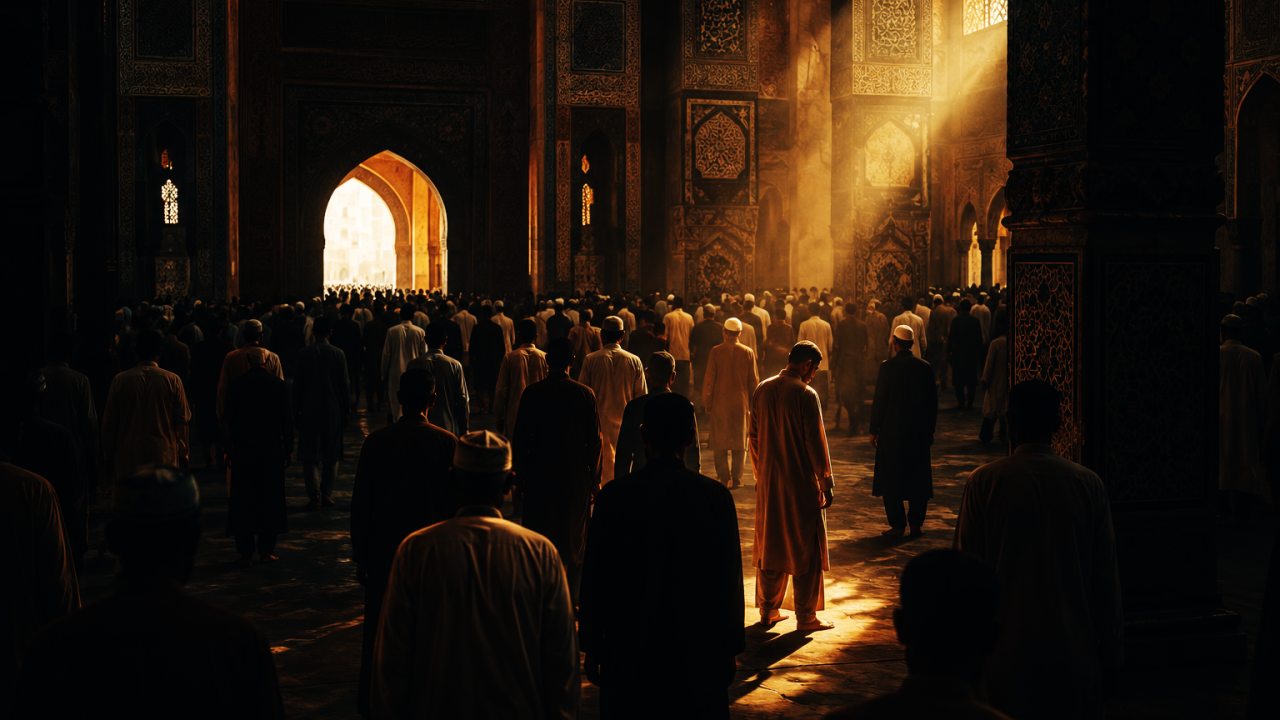
On the lost practice that once held us together
There is a concept in psychology so fundamental that researchers have spent decades trying to measure it, name it, and understand what happens when human beings are deprived of it.
They call it mattering.
Not happiness. Not belonging. Not even love.
Mattering – the felt sense that your existence registers in the life of another person. That someone notices when you arrive. That someone would notice if you didn’t. That your joy lands somewhere. That your pain doesn’t simply dissolve into the air unseen.
It is one of the oldest human needs. Older than language. Older than religion. Present in every functioning community that has ever existed across every civilisation in recorded history.
And it is what an increasing number of Muslims are quietly being starved of not because their communities don’t care about them in principle, but because we have, without realising it, stopped truly seeing one another.
This is not the article I expected to write. But I think it might be the one we most need to read.
Before cities. Before institutions. Before organised religion as we know it. Before anything we would recognise as modern society.
Human communities survived because of one practice so simple it is almost embarrassing to name:
People watched over each other’s lives.
In pre-modern villages across cultures, continents, and centuries the social structure was built around what anthropologists call dense witnessing. Your neighbours knew your harvests and your losses. The community knew your children, your debts, your grief. When someone disappeared from the daily pattern of life, the absence was immediately felt not because there was a system to track it, but because people were genuinely embedded in each other’s awareness.
You were known. Not perfectly. Not always kindly. But known.
Psychologists studying loneliness and community collapse have found something striking: the single greatest predictor of whether a person feels they belong somewhere is not how many people they know, or how often they attend gatherings, or how warm the culture claims to be.
It is whether they believe that specific people would notice if something changed in their life.
Not the community in abstract. Specific people. By name. Who see them.
This is what we have lost. And we have lost it so gradually, so quietly, that most of us don’t even have language for the absence. We just feel it a vague, persistent sense that we are moving through our communities rather than being held within them.
I want to be careful here, because this is not a romanticisation of history. This is an observation about method.
The society the Prophet ﷺ built in Madinah was, among many things, a masterclass in the practice of witnessing.
He knew people’s names. Not as a performance of warmth but as a genuine act of regard. He knew their family situations. He knew who was struggling financially and who carried grief they hadn’t shared publicly. He noticed when people were absent. There are narrations describing how he would ask after those who had not been seen, send someone to check, or go himself.
When Julaybib a man on the margins of society, with no family, no tribe, and no obvious social standing was found martyred on the battlefield, it was the Prophet ﷺ who sat beside him, placed his hands upon him, and said: "This man is of me, and I am of him." (Sahih Muslim)That sentence is extraordinary.
Not: “He was a good Muslim.” Not: “Make du’a for him.” But: He is of me, and I am of him. An explicit, personal, public act of witnessing a life that others had largely passed over.
The early Muslim community did not create belonging by holding more events. They created it by developing an almost radical attentiveness to the lives of specific people around them. The Prophet ﷺ modelled this so consistently that it became the social fabric the connective tissue of everything they built together.
Contrast that with now.
We can attend the same masjid for three years and not know the name of the man who always prays in the same row. We can be in the same WhatsApp group as someone going through the hardest period of their life and respond to their message with a thumbs-up emoji. We can follow someone on social media, see their curated highlights for months, and genuinely believe we know how they are.
We have confused awareness with witnessing. They are not the same thing. Not even close.
Here is where psychology becomes uncomfortable.
Researchers studying social pain the neuroscience of exclusion, invisibility, and feeling unseen have found that the brain processes social rejection and physical pain through overlapping neural pathways. Being ignored, overlooked, or chronically unseen is not a metaphorical wound. It registers, neurologically, as something close to a physical one.
But more relevant to us is what happens over time.
When a person moves through extended periods of life without being genuinely witnessed without someone tracking their growth, noticing their struggles, remembering what they mentioned last month something quiet happens to their sense of self. They begin to experience what psychologists call social invisibility: a state in which a person begins to feel that their inner life, their actual experience of being alive, is not real to anyone around them.
They are present. They show up. They say the right things in the right spaces. But they carry the unsettling feeling that if they disappeared, the gap would close quickly that the community would barely register the shape they left behind.
This is not a feeling reserved for the friendless or the isolated. It lives in people surrounded by other people. It lives in people who attend every gathering, contribute to every cause, smile at every Eid. It is invisible loneliness and it may be the defining spiritual and psychological wound of Muslim community life today.
And here is the part that should stop us:
We are not causing this through cruelty. We are causing it through inattention.
Nobody decided to make their brother invisible. Nobody chose to stop seeing their sister. It happened through the slow accumulation of small omissions the follow-up question never asked, the disappearance never mentioned, the pain never acknowledged because the person seemed fine and we didn’t want to pry.
We stopped witnessing without ever deciding to stop.
To understand how this happened, we need to look honestly at the structure we have built for Muslim community life.
We have, largely without intending to, designed our communities around occasions.
Jummah. Eid. Ramadan. Weddings. Lectures. Fundraising dinners. Islamic conferences. These are the load-bearing walls of how most Muslims experience their community. And there is nothing wrong with any of them. They are important. They are beautiful in their own right.
But occasions, by their nature, are episodic. They create temporary density many people, much warmth, a real feeling of something alive and then they end. And when the occasion ends, most of the connection ends with it.
What we have not built or have allowed to erode is the everyday architecture of witnessing. The ordinary, unremarkable practices through which people are tracked, noticed, and held between the occasions.
In functioning communities throughout history, this everyday architecture had a shape. It was the neighbour who noticed your light wasn’t on. The elder who asked about your child by name. The friend who remembered you mentioned something difficult three weeks ago and came back to it. The person who sat beside you not because there was an agenda but because they simply wanted to be in your presence.
None of this required a programme. It required attentiveness a trained, practised, almost deliberate habit of keeping other people’s lives inside your field of awareness.
We have outsourced this attentiveness to institutions, apps, and announcements. And institutions cannot witness. An app cannot see you. An announcement cannot notice that you’ve been quieter than usual.
Only a person can do that. Only a specific human being, choosing to keep another specific human being in their genuine awareness, can do that.
Not everyone experiences this equally.
In every Muslim community, there are people who are naturally witnessed who have social capital, existing relationships, confident personalities, or the kind of visible presence that generates attention without effort. When something happens in their life, people notice. People ask. People show up.
And then there are people who fall into what I would call the witness gap.
The new Muslim who converted two years ago and still doesn’t quite know where they fit. The divorcee who became suddenly, awkwardly invisible after a marriage that had been celebrated in the same community. The young man who stopped coming to Jummah six months ago, and nobody asked why. The woman who is brilliant and capable and quietly falling apart, and whose competence makes it easy for others to assume she doesn’t need anything. The older person whose social world has slowly contracted as friends moved away or passed on. The family that doesn’t speak the dominant language of the community well enough to build relationships past greetings.
These people are not asking for rescue. They are not necessarily in crisis though some are.
They are asking, in the wordless way that human beings ask, to be seen.
And the unbearable irony is this: they are surrounded by people who would, if asked, say they care about the Ummah. Who would, in an emergency, show up. Who are not cold-hearted or indifferent.
They have simply never been trained to notice. They were never taught that witnessing is a practice a skill a form of worship, even.
Allah ﷻ says in the Quran: “The believers are but one brotherhood.” (Al-Hujurat, 49:10)
The word used ikhwah is not describing a sentiment. It is describing a structure. A brotherhood, in the language and culture of the Quran’s revelation, was a bond of active, practical, mutual obligation. You knew your brother’s situation. You bore witness to his life. You were present in it.
The Prophet ﷺ described the believers as being like one body when one part suffers, the whole body responds with fever and sleeplessness. (Sahih al-Bukhari, Sahih Muslim)
Think about what this metaphor actually requires. For the body to respond to pain in one of its parts, the body must be continuously aware of that part. The nervous system does not wait for a formal notification. It is in constant, quiet, attentive communication with every limb, every organ, every layer of tissue.
It witnesses continuously.
That is the biological model Allah’s Prophet ﷺ used to describe how Muslims should relate to one another. Not occasional emergency response. Not showing up when things become catastrophic and undeniable. But a state of ongoing, attentive awareness so finely tuned that pain registers before it becomes a crisis.
We have lost this. Not the love I think the love is still there, buried and genuine. But the practice of attentiveness that love requires to become real in another person’s life.
And recovering it is not complicated. It is just countercultural. It requires us to slow down in a world that rewards speed. To be specific in a world that rewards scale. To invest in the person in front of us in a world that is constantly pointing us toward the person beyond them.
It does not look like a programme. It does not require a committee.
It looks like this:
You notice that someone who is usually at Jummah hasn’t been for three weeks. You don’t assume they’re fine. You reach out not with a broadcast message to the group, but to them, specifically, by name.
It looks like remembering. Someone told you last month that they were waiting for difficult news. You go back to them. Not because something dramatic happened. Because you carried their worry with you and you didn’t put it down.
It looks like the second question. Not “How are you?” followed by moving on but “How are you?” followed by genuine stillness, genuine waiting, genuine interest in whatever answer comes.
It looks like making someone’s existence explicit. Telling them: I notice you. I remember what you said. You are not invisible here.
It looks like keeping the quieter people inside your awareness not just the loud ones, the confident ones, the ones who make it easy to care about them.
It looks like recognising that the person sitting two rows from you in Jummah the one you’ve never spoken to is living an entire life that you know nothing about. And deciding that this is something worth changing.
It looks like asking yourself, regularly and honestly: Who in my community is living unseen right now? And am I doing anything about it?
A body is not one because its parts are similar. The eye looks nothing like the kidney. The heart operates on a completely different logic than the skin. Every organ has a distinct composition, function, and place.
What makes them one body is not their sameness.
It is that they are continuously aware of each other. They communicate. They respond. They adjust based on what other parts need. They are embedded in a single, ongoing system of mutual attention.
This is the vision. Not a Muslim community where everyone agrees on everything, or speaks the same language, or comes from the same background, or practises their faith in identical ways.
A Muslim community where people are genuinely inside each other’s awareness. Where your presence is noticed and your absence is felt. Where the specific texture of your life your struggles, your growth, your quiet victories and your unspoken fears registers in the hearts of specific people around you.
Where you are witnessed.
That is what brotherhood was always meant to be. Not a label. Not a legacy. Not a feeling reserved for moments of collective crisis.
A continuous, ordinary, irreplaceable act of seeing.
Not “What can we do to improve our communities?”
That question is too large. It lets us off the hook by making the answer someone else’s responsibility.
Instead:
Who in your life right now in your masjid, your neighbourhood, your network, your family is living without being witnessed?
Who is moving through their days with the quiet, unspoken weight of feeling unseen? Who has been performing fineness for so long that everyone has taken the performance at face value? Who disappeared from a space you share and you noticed, and you thought about reaching out, and you didn't?You don’t need to fix their life. You don’t need to have answers.
You just need to see them. Specifically. By name. In the ordinary, unremarkable, profound act that human communities have always been built on and that we have quietly, without meaning to, forgotten how to do.
Community does not begin with a movement.
It begins with one person deciding that another person’s life will not pass unseen on their watch.
See someone this week. Not the crowd. Someone.
A newsletter about what genuine belonging actually requires and what it costs us when we settle for less. Part of the MUALAQ vision: rebuilding the lost art of human connection within Muslim communities.
If this touched something real in you:
Tell me not what you think about community in general, but something specific. When did you last feel truly witnessed by someone in your community? And when did you last make someone else feel that way?
If you know someone who is living in the witness gap right now share this with them. Not so they know the theory. So they know someone saw them enough to send it.
The body heals when its parts remember they can feel each other.

There's a man who prays next to you every Friday. You recognise his shoes. You know which row he takes. You've stood…
On the ancient cure for the modern loneliness epidemic sitting right in front of us, five times a day. There is a…
THE HADITH WE QUOTE AND RARELY SIT WITH SAHIH AL-BUKHARI 644, SAHIH MUSLIM 651 "By Him in Whose Hand my soul is,…