Community Building
 IFTIKHAR UL HAQ
September 3, 2026
13 min read
We Had the Perfect Third Place. We Turned It Into a Car Park.
 IFTIKHAR UL HAQ
September 3, 2026
13 min read IFTIKHAR UL HAQ
September 3, 2026
13 min read
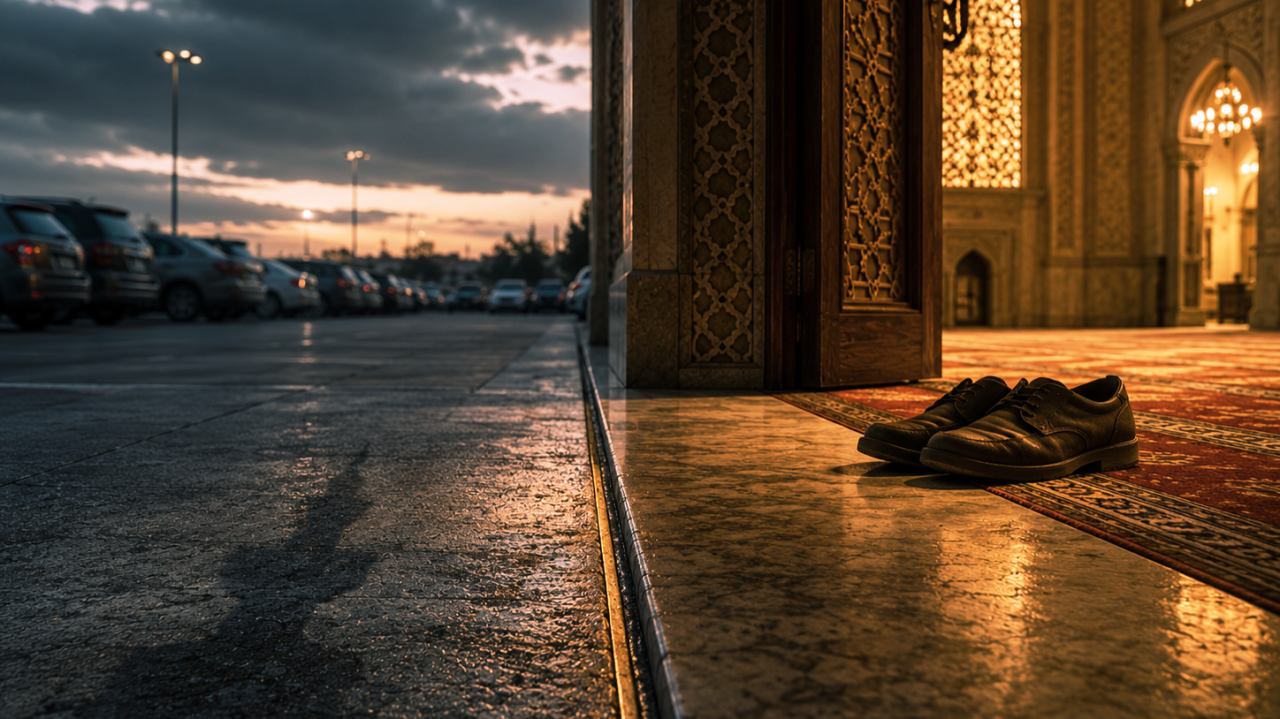
On the ancient cure for the modern loneliness epidemic sitting right in front of us, five times a day.
There is a term that sociologists invented in 1989 that the entire world is now desperately Googling in 2026.
Not your home. Not your workplace. The third place the space in between, where you belong to nothing and no one specifically, where you arrive without an agenda and leave without a transaction, where you are simply a human being among other human beings, and that alone is enough reason to be there.
The corner café where the owner knows your order. The barbershop where the conversation never really ends. The library where nobody asks what you’re doing there. The park bench where strangers become, over months of accidental repetition, something that feels almost like neighbours.
Third places are the spaces that exist outside of home and work the neighbourhood coffee shops, libraries, bookstores, parks, recreation centres, and casual gathering spots where connection happens organically. These spaces don’t require productivity, performance, or perfection. You just show up as a human among other humans.
Sociologist Ray Oldenburg, who coined the term, identified something specific about what makes a third place work. It must be neutral ground no one hosts, no one owes, you come and go freely. It must be a leveller status from elsewhere doesn't transfer, the barbershop doesn't care about your job title. And conversation must be the activity, or available alongside whatever else is happening playful, unagendaed, with regulars setting a tone that newcomers absorb.Read that list again.
Neutral ground. No agenda. Status doesn’t transfer. You just show up.
Now tell me does that description remind you of anywhere?
Third places thinned out suburbanised, priced out, screen-replaced and loneliness statistics climbed in parallel until surgeons general began issuing advisories about connection as a health crisis.
The US Surgeon General has declared loneliness a public health crisis. Research has shown that chronic loneliness is associated with depression, cardiovascular disease, and even increased mortality risk.
Nearly 60 percent of young adults between 18 and 24 report negative effects on wellbeing due to loneliness. Governments are appointing Ministers of Loneliness. Urban planners are frantically redesigning cities around the concept of accidental human encounter. Architects are being commissioned to build spaces where people might just might end up talking to someone they didn't already know.The world is spending billions trying to rebuild something it lost.
And Muslims have been walking past it five times a day without recognising what it is.
The Masjid was not just a house of prayer.
It was the original third place. The most sophisticated community infrastructure ever built. And we turned it, slowly and without meaning to, into something closer to a spiritual petrol station arrive, fill up, leave, do not make eye contact.
When the Prophet ﷺ arrived in Madinah after the Hijra, the very first thing he built was not a home for himself.
It was a Masjid.
The importance of mosques is such that the first development the Prophet ﷺ established when he reached Madinah was the mosque. It was primarily a place of worship for Muslims but additionally, it served as a place of gathering to learn the religion, and a place of councils where the Prophet ﷺ and his companions discussed important matters related to their daily activities and social life.
Activities other than prayers included even sports and gathering for various needs of the society.
Read that carefully.
Sports. Gatherings. Social needs. Councils. Learning. Consultation.
The Prophet ﷺ built a space that was simultaneously a place of worship, a community centre, a court, a school, a place of rest, and a space where people who had nowhere else to go could simply be. The Companions slept there. Delegations were received there. Disputes were resolved there. The poor were sheltered there.Oldenburg’s criteria for a perfect third place neutral ground, no agenda, status doesn’t transfer, regulars welcome newcomers describes the Masjid of the Prophet ﷺ with an accuracy that should stop us cold.
We did not need to invent the third place.
We inherited it.
And then, gradually and entirely without intending to, we dismantled most of what made it one.
Nobody decided to make the Masjid cold. Nobody voted to remove the belonging from it. It happened the way most community erosion happens through a series of individually reasonable decisions that accumulated into something nobody would have chosen if they could see the full picture.
We separated the Masjid from daily life. In the original model, the Masjid was embedded in the community physically, socially, functionally inseparable from the rhythm of ordinary existence. People did not drive to it from distant neighbourhoods. They walked to it from their homes, and the walk itself was part of the social fabric. They passed neighbours. They stopped. They talked. The Masjid was not a destination. It was a heartbeat.
We made it formal. There is a particular kind of silence in many Masajid today the silence of a space that has communicated, through its architecture and its culture, that certain things are not appropriate here. Laughter, perhaps. Lingering. Questions that do not have obvious religious answers. The conversation that begins with nothing in particular and leads somewhere real. We built beautiful Masajid and filled them with a formality that makes spontaneous human connection feel almost intrusive.
We optimised for throughput. The modern Masjid experience, in many places, has been unconsciously designed for efficient prayer delivery. The congregation arrives. The Adhan sounds. The prayer is performed. The congregation disperses. The entire interaction takes, in many communities, less time than a coffee order. There is nothing wrong with the prayer itself. But when the prayer becomes the entirety of the experience when the space before and after it holds nothing that invites people to stay, to meet, to simply exist together the Masjid has lost something essential.
We let status transfer in. The one thing Oldenburg insists a third place must never allow the ranking of people by their external worth quietly entered our Masajid through culture. The respected families with their established positions. The visible donors acknowledged from the mimbar. The social hierarchies of nationality and language and income and religious knowledge that determine, informally but unmistakably, who belongs in which circle. The newcomer who stands alone after Jummah, not because anyone is hostile, but because the existing social architecture has no obvious place for them.
When we are in third places in person, we might be right next to someone who doesn’t think like us or navigate the world in the same way. That productive encounter with difference the stranger who surprises you, the conversation you didn’t expect to have was once the ordinary texture of Masjid life. It has become, in many communities, the exception.
Adults in neighbourhoods with inaccessibility to third places reported significantly higher levels of isolation, loneliness, immobility, and overall poorer health indicators.
Now consider the particular cruelty of the situation we have created.
Muslim communities have a third place. Many Muslims live within walking distance of one. They attend it regularly sometimes five times a day. By every external measure, they should be among the least lonely people in the world.
And yet the research on Muslim community life tells a different story. Young Muslims reporting that they feel unseen in their communities. Newcomers who attend Jummah for months without a single person learning their name. Elders who pray in the same row every Friday and could not tell you a single fact about the man beside them. People who experience the Masjid as a place of spiritual connection with Allah and social disconnection from everyone else.
We have the infrastructure. We lost the culture.
The Masjid is still standing. What the Prophet ﷺ filled it with the attentiveness, the staying, the genuine interest in the person beside you, the refusal to let anyone remain a stranger for long that is what we allowed to quietly drain away.
The Prophet ﷺ said: “The most beloved of places to Allah are the Masajid.” (Sahih Muslim, 671)
He did not say the most beloved places to Allah are the most architecturally impressive, the most efficiently managed, or the most theologically rigorous.
The most beloved.
Beloved things are not places you pass through. They are places you stay.
Here is where the modern pain point becomes almost unbearable in its irony.
The decline of third places cafés, places of worship, and community spaces that once produced casual contact has thinned out in many places, and the loneliness statistics have climbed in parallel.
And in the vacuum left by the disappearance of genuine third places, an entire economy has emerged to sell people what community used to provide at no cost.
Paid wellness apps. Subscription-based social clubs. Co-working spaces charging hundreds a month for the privilege of being near other human beings. AI companion services. Rent-a-Friend platforms. Apps designed to simulate the feeling of being known.
Muslims are paying for these too. Muslim professionals joining networking groups, paying for community access, downloading apps designed to manufacture the sense of belonging that was meant to be theirs by birthright every time they walked into a Masjid.
We gave away something priceless.
And then we paid strangers to approximate it.
The answer is not a new programme. It is not a renovation. It is not a budget.
It is a decision made by specific people in specific communities to recover what the Masjid was always meant to be.
The Masjid was not only a place of worship but a centre for community gatherings, consultation, and learning. The Prophet ﷺ himself participated in the construction of the mosque, emphasising the importance of unity and collective effort in building a strong community.
That unity and collective effort begin with something far simpler than construction.
Stay after the prayer. Not every time. Not with an agenda. Just stay. The culture of immediate dispersal after Salah is one of the most powerful forces dismantling community life in Muslim spaces. The ten minutes after Fajr. The conversation after Isha. These are not wasted time. They are where community happens. They are where the stranger becomes familiar, the familiar becomes known, and the known becomes someone you would actually call.
Learn the name of someone new every Jummah. Not as a programme. As a personal decision. One name. One genuine exchange. Not “where are you from” which is a sorting question but “what brings you here, what do you do, how long have you been in this area.” Questions that treat a person as a human being rather than a demographic.
Create space without agenda. A halaqah, a community meal, a regular gathering after Asr not to deliver content, not to fundraise, not to announce, but simply to exist together in a space where nothing is required of anyone except their presence. This is what the Masjid of the Prophet ﷺ provided continuously. It is what most modern Masajid have entirely stopped providing.
Let the Masjid hold the ordinary. The person who needs to sit somewhere quiet. The teenager with nowhere purposeful to go after school. The new Muslim who doesn’t know anyone yet. The elderly man whose entire social world has contracted to this building. The Masjid was built to hold these people not as charity cases but as members. Let it hold them again.
Refuse to let anyone remain a stranger for long. The Prophet ﷺ noticed absence. He asked about people by name. He sent someone to check on those who had not been seen. This is not a special programme. It is the basic attentiveness of a community that takes seriously the idea that every person who walks through the door is a member not a visitor, not a guest, not someone else’s responsibility. Ours.
A body needs a heart an organ that does not wait to be called upon, that beats continuously, that pumps life to every part of the body without preference or hierarchy, that never closes its doors because the hours are over.
The Masjid was designed to be that heart.
Not the most impressive organ. Not the most sophisticated. But the one whose rhythm, felt or unfelt, is what keeps everything else alive.
Between 2019 and 2021, there was a rapid decline in third place availability those gathering spaces outside of home and work. Governments are alarmed. Urban planners are scrambling. Architects are being commissioned. Billions are being spent trying to rebuild what was lost.
And we have it.
We have always had it.
Five times a day, in communities across the world, a door opens and an Adhan sounds and people come from their homes, from their work, from their ordinary lives to a space that was designed by the greatest community builder in human history to be exactly what the lonely modern world is desperately trying to recreate.
We just have to remember what it was built for.
And decide starting this Friday, in your specific Masjid, in your specific community to stay a little longer.
To learn one name.
To ask one question.
To treat the space after the prayer not as the end of the visit but as the beginning of the belonging.
The third place was never lost.
It was waiting, five times a day, for us to come back to it.
A newsletter on linkedin about recovering what genuine Muslim community was always designed to be and what it costs us when we settle for less.
Part of the MUALAQ vision: rebuilding Muslims’ connection to their Masjid, their community, and each other.
Before you walk to your car after Prayer
stop.
Turn around.
Learn one name.
That is where the third place begins again.
And if this issue reached something real in you share it with the person you always see at Jummah but have never spoken to. Let the article be the introduction.
The door is already open. We just stopped walking through it together.
Research sourced from: Axios (July 2026), Simply Psychology (April 2026), Psychology Today (February 2026), Congress for New Urbanism (January 2025), and the sociological framework of Ray Oldenburg’s The Great Good Place (1989).

On the lost practice that once held us together There is a concept in psychology so fundamental that researchers have spent decades…
There's a man who prays next to you every Friday. You recognise his shoes. You know which row he takes. You've stood…
THE HADITH WE QUOTE AND RARELY SIT WITH SAHIH AL-BUKHARI 644, SAHIH MUSLIM 651 "By Him in Whose Hand my soul is,…